Showing posts with label review by Jennifer. Show all posts

A Valley of Betrayal by Tricia Goyer


A Valley of Betrayal is Tricia Goyer's first novel in a new series. First, I will admit my stupidity. I had seen the rich hues on the cover of this upcoming novel, and knew it was about the Spanish Civil War, which I assumed was sometime in the nineteenth century.
Let Tricia tell you the truth about the story behind this novel:


From July 17, 1936-April 1, 1939, well before America was involved in World War II, another battle was fought on the hillsides of Spain. On one side were the Spanish Republicans, joined by the Soviet Union and The International Brigade—men and women from all over the world who have volunteered to fight Fascism. Opposing them, Franco and his Fascist military leaders, supported with troops, machinery, and weapons from Hitler and Mussolini. The Spanish Civil War, considered the “training ground” for the war to come, boasted of thousands of American volunteers who joined to fight on the Republican side, half of which never returned home. Unlike World War II, there is no clear line between white and black, good and evil. Both sides committed atrocities. Both sides had deep convictions they felt worth fighting and dying for. During the Spanish Civil war, terror tactics against civilians were common. And while history books discuss the estimated one million people who lost their lives during the conflict, we must not forget that each of those who fought, who died, had their own tales. From visitors to Spain who found themselves caught in the conflict, to the communist supporters, Basque priests, and Nazi airmen . . . each saw this war in a different light. These are the stories behind A Valley of Betrayal.


This was a great story, so complex and about a place and time that I knew nothing about. This book is especially for you if you love war stories. In this novel, Spain, and the people of wartime Spain, definitely stood out as characters adding to the plot in their own right. The description was so rich that the reader can almost see it, feel it, hear it and smell it. I asked Tricia to elaborate on her process of researching a book where the setting is so real. Do you complete the research or the story first, or do you work on them concurrently?


I have a basic idea for a story when I sit down and write. Then I work on the layers back and forth. I work on the people. Then I research history. Then I research the place. It's like basket-weaving, one color of thread (rope?) goes in, then I add another. Once the platform is done, I add more--building up the story. This is the hard part, working on the layers. Once my basket is done, then it's easy to fill up the pages. I know the place. I know the people. I know their dreams, motivations, fears and that's when the story starts to flow! The story pours through my fingers as if I'm just writing out what is already there.


The other facet of the book that really stood out to me were the thoughts and voice of Sophie, as an artist. How do you think that the experience of writing compares to visual art, such as painting, and how are they similar and different as far as interpreting situations that the artist encounters?


Personally, I think artists have the same way of interacting with the world--they just share their feelings and thoughts in different ways. They see the world, take it in, then want to express it in their own interpretation. Sophie did that through painting. I do that through words. I don't know what I'm feeling until I put it on paper, and I think visual artists are the same.

I had a teacher once who said. . . that great art is only created when you discover the truth of what lies before you, and the truth found within, and you express it on the canvas. That's why I think I'd paint more beautifully here than anywhere else. I've found my heart, despite the war. --Sophie in A Valley of Betrayal (p. 78)


Posted by Jennifer Donovan, regular reviewer

Arms of Deliverance by Tricia Goyer


First off, let me start by saying I really liked this book.


Arms of Deliverance by Tricia Goyer is set in Europe in World War II. What I liked about it is that the history was simply a rich background which provided depth to some of the characters, and not an obtrusive additional element that the reader keeps having to navigate around. The book started pretty quickly, which was refreshing, because it seems like it has taken me a while to get into the last few novels I've picked up. I liked these characters. There were several story lines, loosely woven together, which weren't at all hard to separate. One thing that was a little difficult for me is that within the first 26 pages six or eight main characters were introduced. After I started feeling lost, I actually wrote down the characters as they were introduced and then it was fine (and to be fair, I did read the first couple of chapters before bed and I probably wasn't as mentally sharp as I could have been).


There's been a lot of talk about "Christian fiction"--if you read it and why or why not, what the problems are with it, what should be done about it etc etc. I have to say that as a semi-literary type (I was an English major and I do like a good literary novel on occasion), I don't read a lot of Christian fiction. There are a few reasons for that. One is that I don't generally enjoy historical fiction or historical romance specifically, and it seems like much of the Christian fiction published until recently fell into this category. There's a great market for it, and I'm not looking down my nose at it, but it's just not my preference. Another reason that I don't read a lot of Christian fiction is that it's not readily available in my library, and I generally spend my book dollars on nonfiction and get my fiction from the library.


That said, I look forward to reading some of Tricia Goyer's other fiction. There are three other books in this "series" (which from what I can gather is tied together by the fact that they are all set in World War II, but with different characters and different settings).


Jennifer Donovan, regular contributor

PS. Don't forget to comment for a chance to win a copy of Jennifer Macaire's Horse Passages! The contest ends Monday!

Quaker Summer by Lisa Samson


Heather "Hezzy" Curridge is like so many women today. She has it all and yet still feels unfulfilled and wants to have and do more. She and her husband are raising a teenaged son who is sometimes a target for the bullies, which reminds her of her own mistakes in this arena from her school years. In this novel by Lisa Samson, we follow her journey as a church dropout to try to find a way to better know and serve God and God's people. We also follow the journey of a married couple who might be drifting apart. We follow the journey into Heather's past, and her bold steps towards helping to create a new future for her and her family.

Lisa Samson has a wonderful insight into people. Through Heather, she analyzes a woman's guilt at overeating, overachieving, and overspending. She examines women's friendships--some genuine and some superficial, as well as the obstacles that we create that hinder finding new friends or going deeper with the ones that we have. Characters are described, but then as they act, they leap off the page at you.

One thing that I love about her novels are that they are so diverse. Each novel features a rainbow of characters who have different skin colors, different ages, different ways of worshiping God, different gifts and different personalities, indirectly challenging us to look at the people in our lives, or the people who aren't in our lives.

Quaker Summer is a novel that you will enjoy as each chapter introduces a new character, a new story, or a new issue that Heather is wrestling. The book also contains a reader's guide, so the topic, along with the provided questions would make it an excellent book club choice.

Reviewed by regular contributor Jennifer.

Northanger Abbey by Jane Austen


I enjoyed Northanger Abbey by Jane Austen a good bit. The book jacket described it as "the most joyous of Jane Austen's novels," so I looked forward to a light and encouraging read. That is pretty much how I would describe it. I wanted to read something by Jane Austen, because I wasn't sure I ever had. I may have read Pride and Prejudice in school, and I know I've seen the movie, and the movie of Emma as well.


Jane Austen was able to draw me into her characters, even with a somewhat detached third-person sort of story-telling. She begins the story about Catherine, the unlikely heroine, and periodically inserts her narrator's voice in this way throughout the story. However, in spite of this, I found myself saying, almost out loud at times, "How dare you do that! Leave her alone! Stop lying!" or something along those lines. It also made me long for the genteel life of a young English woman, with nothing more to do than read and discuss novels, take strolls, and enjoy elaborate meals, in between dances and other social events.

I wanted to dip into the Jane Austen well. I did, and I will do so again soon.


Posted by Jennifer Donovan, regular contributor

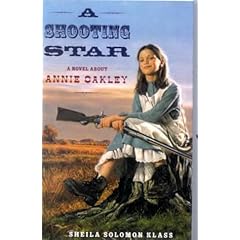
A Shooting Star: A Novel about Annie Oakley by Sheila Solomon

A Shooting Star: A Novel about Annie Oakley by Sheila Solomon
This is a novel, as the title clearly states, however Sheila Solomon Klass includes a bibliography of her sources at the end, showing her extensive resources, and clarifying which facts and characters are real and which are composites or fictionalized. I found out many things about Annie, one of the first being that she changed her name (even before she was in the Wild West show). I also learned that she was the daughter of a practicing Quaker mother, and that due to poverty and other family circumstances, she had to be sent to the Infirmary, which was a repository for orphans and other children whose parents could not care for them. Annie's surprising talent of shooting, and the way she uses it, is covered throughout the book. As one might imagine, it was frowned upon as unladylike in the late 1800's when she lived:
Proper girls did not ever shoot. That was the rule. I thought it was a silly rule. I still think so. Silly because I can't see any reason to stop a person who has talent just because that person is a girl. Ma herself was the one who first named mine. A shooting talent.Who says that boys are the only ones allowed to have talents and use them?
Because big issues such as poverty and cruelness (which is contrasted with kindness) are covered and lend themselves to discussion, and because of the first-person narration, it is an excellent read-aloud book. When I read this scene, I looked over at my daughter and saw her wheels turning, and so we took a moment to discuss it:
I heard the two of them talking softly by the fireside long into the night. I heard that word mortgage, mortgage, mortgage whispered over and over, fearfully. Mortgage is the second worst word in the English language. The first worst word is death.
I would recommend this as a read-aloud for ages eight and up, and as a stand-alone book for ten and up. It's one children's novel that I think that adults would really enjoy on their own as well (which is another reason it's such a strong candidate for a read-aloud).There's one problem with this novel that was published in 1996--it's out of print. However, there are some used copies available at Amazon, and I found it in my public library, where they had several copies. It was such an enjoyable book that I didn't want to let this stop me from recommending it.

This review was written and submitted by Jennifer.

Regular Reviewer (see bio in the sidebar)